
close
Choose Your Site
Global
Social Media


Views: 0 Author: Site Editor Publish Time: 2026-08-26 Origin: Site


Sourcing commercial equipment carries incredibly high stakes for any production facility. Under-specifying your hardware leads to frustrating production bottlenecks. Over-specifying unnecessarily traps your essential working capital. We must frame this sourcing decision properly. It is not just a basic hardware purchase. Rather, it stands as a strategic business investment. The equipment you choose directly dictates turnaround times, daily labor costs, and final product quality. Choosing poorly means missed deadlines and lost clients. Choosing wisely ensures smooth operations and scalable growth.
This guide translates complex technical parameters into actionable business outcomes. You will discover exactly how to evaluate physical hardware limits. We will explore automation features and assess vendor reliability thoroughly. You will learn how to align technical specifications with your unique production goals. We will help you shortlist the perfect equipment confidently.
Production dictates specs: Needle count and head count must align directly with your target daily output and design complexity.
Speed is subjective: Advertised Stitches Per Minute (SPM) rarely reflects real-world operational speed; auto-trimming and setup times matter more.
Tech drives margins: Sourcing an advanced embroidery technology embroidery machine reduces labor costs through automation (e.g., laser alignment, automatic tension).
Supplier reliability equals uptime: An embroidery machine supplier's post-sale SLA (Service Level Agreement) is just as critical as the machine's hardware specs.
To evaluate embroidery machine specifications properly, you must first define your fundamental success criteria. Buyers often skip this crucial step. Establish exactly how to calculate your required daily output before looking at brochures. You must answer several operational questions clearly. Are you producing mostly structured hats? Do you focus heavily on flat garments like polo shirts? We recommend using a simple formula to determine baseline hardware needs. First, calculate the average stitch count across your typical product range. Next, factor in your target daily volume. Finally, account for standard shift hours. This reveals the actual stitching capacity your facility requires daily.
Once you define your baseline capacity, you must evaluate configuration types. You will choose between single-head and multi-head configurations.
Single-head (Commercial): These units represent the ultimate standard for versatility. They work best for bespoke, low-volume, or highly customized orders. You can dedicate a single-head unit to personalized gifts or complex prototypes. They handle one-off jobs quickly without disrupting larger production runs.
Multi-head (2, 4, 6, 8+): These machines act as the backbone of high-volume manufacturing. They prove essential for uniform, high-volume B2B orders. A six-head machine stitches six identical left-chest logos simultaneously. They multiply your output drastically while utilizing only one operator.
Frame architecture represents another critical architectural decision. You must briefly map frame architecture to your intended product categories. Tubular machines feature a unique open arm. You slide finished garments, like shirts or bags, directly over this arm. They suit standard apparel decoration perfectly. Conversely, flatbed frame types feature a massive flat table surface. They handle flat fabrics, home textiles, and large unassembled panels efficiently. Selecting the wrong frame type prevents you from fulfilling customer orders. It leaves you sourcing incompatible equipment that limits your capabilities.
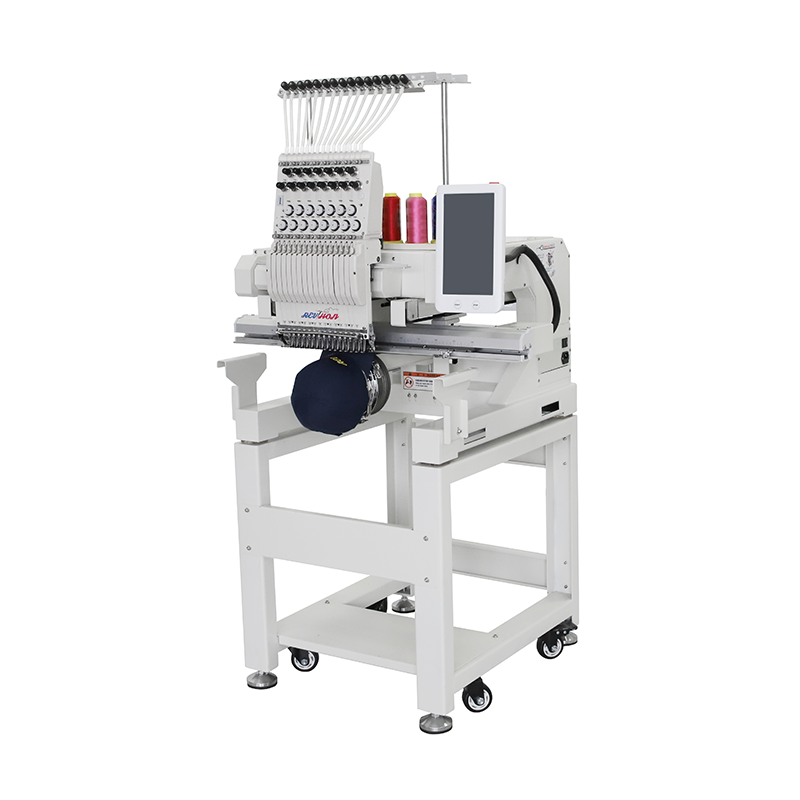
Let's decode the actual hardware limits of an industrial embroidery machine. Understanding these parameters prevents costly production errors.
Needle count directly impacts operational efficiency. Buyers often wonder about the operational difference between 10, 12, and 15-needle machines. A 10-needle machine limits you to ten colors per design. A 15-needle machine holds fifteen distinct colors simultaneously. Higher needle counts reduce machine stoppage drastically. Operators waste precious minutes stopping the machine to change threads manually. Complex corporate logos frequently demand exact brand colors. Decision factor: Choose higher needle counts to eliminate thread changes on complex designs. This simple upgrade maximizes daily output efficiency.
The maximum embroidery area dictates the physical size of your designs. Many buyers underestimate the risk of restrictive hoop sizes. A small field size limits you to basic left-chest logos or small cap designs. If a client requests a full jacket back, a small machine cannot physically accommodate it. You must split the design awkwardly or decline the job entirely. Decision factor: Compare maximum X/Y axis limits carefully. Measure them against your largest anticipated design. Always purchase slightly more field size than you currently need.
We must debunk the pervasive "max speed" myth immediately. Manufacturers frequently advertise absolute maximum speeds, like 1200 SPM. However, running a machine at maximum speed invites disaster. It causes severe vibrations and frequent thread breaks. Motor type plays a crucial role here. Servo motors offer better continuous reliability than older stepper motors. Servo motors adjust power dynamically. They maintain exact needle penetration force constantly. Decision factor: Look for sustainable cruising speeds. Most commercial shops run equipment between 800 and 1000 SPM safely. Factoring in thread breakage risks reveals your true production speed.
Hardware represents only half of the equation. Modern software integration dictates your overall shop efficiency significantly.
First, assess the machine's software ecosystem and format compatibility. Network connectivity matters for file transfers. Modern machines must support Wi-Fi, USB, and LAN connections. This allows digitizers to push files directly to the production floor seamlessly. You must also verify supported digitizing formats. The equipment must read industry-standard files like .DST and .DSB flawlessly.
When investing in an advanced embroidery technology embroidery machine, outline the non-negotiable features clearly. Automated workflow features save countless labor hours weekly. You should demand the following capabilities:
Automatic thread trimming and color changing: The machine must cut threads between design elements automatically. It must switch needles for different colors without operator intervention.
Laser positioning systems: This technology ensures exact design placement on the garment. Operators line up the laser with a marked center point. It reduces human error and ruined garments drastically.
Intelligent thread break detection: Advanced sensors monitor thread tension continuously. The machine stops instantly if a top or bottom thread snaps. This prevents missing stitches in the final design.
Finally, scrutinize the User Interface (UI). The control panel acts as the brain of your operation. The importance of a responsive touchscreen control panel cannot be overstated. It must feature generous onboard memory to store frequently used logos. Real-time design rendering allows operators to preview the stitch path visually. This feature improves operator efficiency and builds confidence before hitting the start button.
Buying the equipment introduces new physical logistics to your facility. You must address these implementation realities proactively.
Address the physical footprint and power requirements first. Commercial machines weigh hundreds of pounds easily. A multi-head unit can span several feet in length. Measure your doorways, hallways, and designated floor space meticulously. Ensure the machine can physically enter your building. Address necessary electrical infrastructure immediately. Single-head units often utilize standard 110V outlets. However, massive multi-head configurations typically require dedicated 220V lines. Consult a certified electrician before finalizing your equipment purchase.
Next, understand the routine maintenance burden. Machines require constant care to maintain pristine stitch quality. We must differentiate between operator-level maintenance and technician-level servicing. Operators handle daily upkeep tasks. Technicians handle complex mechanical interventions.
Table: Operator vs. Technician Maintenance Responsibilities
Maintenance Task | Responsibility | Frequency |
|---|---|---|
Oiling rotary hooks | Operator | Daily |
Cleaning bobbin cases | Operator | Daily / Between shifts |
Replacing worn needles | Operator | As needed |
Adjusting mechanical timing | Technician | Annually / Upon failure |
Replacing drive belts | Technician | Every 2-3 years |
Finally, consider vibration and noise reduction. Industrial sewing creates intense kinetic energy. You must evaluate the machine's chassis construction. Heavy-duty cast iron or reinforced steel frames absorb vibrations effectively. Why does this matter? Excessive vibration degrades stitch precision rapidly. It also creates overwhelming noise on the production floor. A robust chassis ensures continuous stitch precision and helps maintain strict facility compliance over time.
Hardware specifications mean nothing without robust vendor support. Partnering with a reliable embroidery machine supplier matters immensely. A machine is truly only as good as its uptime.
Evaluate post-sale support and SLAs thoroughly. Outline exactly what to demand from your supplier. Ask for guaranteed response times for technical inquiries. Will they call back within two hours or two days? Check if they offer remote diagnostic capabilities. Many modern vendors can log into your machine's software remotely. They troubleshoot error codes instantly without dispatching a physical technician.
Parts availability directly impacts machine longevity. You must assess the risk of purchasing white-label machines. These generic units often utilize proprietary, hard-to-source parts. When a unique component breaks, you might wait weeks for international shipping. Instead, prioritize machines built with industry-standard components. Look for highly respected parts like Koban rotary hooks. Standardized parts ensure local mechanics can service your equipment quickly.
Assess the vendor's training and onboarding protocols. An instruction manual rarely suffices for commercial equipment. Ascertain whether the supplier provides direct on-site installation. Do they offer comprehensive operator training? A skilled trainer teaches your staff proper hooping techniques, tension adjustments, and basic maintenance. Proper onboarding accelerates your path to profitable production.
Finally, perform rigorous warranty scrutiny. You must read the fine print carefully. Manufacturers rarely offer blanket warranties covering the entire machine identically. They separate the electronic warranty from mechanical parts and labor warranties. For example, electronic circuit boards might carry a one-year warranty. Heavy mechanical parts might carry a five-year warranty. Labor coverage often expires after merely ninety days. Understand these tiered structures to avoid unexpected repair bills later.
Successful sourcing requires balancing immediate technical specs with long-term operational realities. Needle counts, field areas, and motor types dictate your immediate capabilities. However, routine maintenance, automation features, and vendor support ensure your long-term success. You must weigh these elements equally during your evaluation process.
We advise buyers to build a weighted spec matrix. Rank your top three business priorities clearly. Base this matrix on your target output volume, desired operational versatility, and upfront budget constraints. This structured logic helps you eliminate inappropriate models quickly. It keeps your purchasing decision grounded in concrete business needs rather than flashy marketing terms.
Do not finalize any purchase blindly. Encourage your team to request sample stitch-outs from your shortlisted suppliers. Ask them to stitch your most complex corporate logo on a challenging fabric. Review the final quality closely. Contact a dedicated sales engineer today to audit your specific production needs. Their technical expertise will validate your final hardware selection.
A: You should look for machines featuring 12 to 15 needles. The commercial standard favors 15 needles. This capacity minimizes costly downtime significantly. Operators spend less time changing thread cones manually during complex, multi-colored corporate logo runs.
A: No, raw SPM rarely guarantees faster turnaround times. High speeds often increase thread breaks. Frequent thread breaks, manual hoop changes, and slow setup times destroy daily efficiency. Consistent cruising speeds paired with auto-trimming impact total turnaround much more than absolute maximum speed.
A: Commercial warranties typically utilize a 1 to 5-year tiered structure. Vendors often provide 5 years of coverage on heavy mechanical parts. Electronic components usually receive 1 to 2 years of coverage. Labor warranties are generally the shortest, often expiring after 90 days to 1 year.
A: Yes, commercial tubular machines handle both formats easily. They achieve this dual functionality through specialized attachments. You must ensure the machine features a wide-angle cap system and a functional drop-table design to swap between hats and flat jackets smoothly.


