
close
Choose Your Site
Global
Social Media


Views: 0 Author: Site Editor Publish Time: 2026-09-30 Origin: Site


Scaling production to include jacket backs, banners, and oversized appliqués introduces critical mechanical limits. Software modifications alone cannot solve these physical barriers. Sizing up requires a fundamental shift in how you evaluate and purchase equipment. The physical constraints of an embroidery machine embroidery area dictate exactly what you can produce. More importantly, they determine how profitably you can produce those items day after day. Standard entry-level setups often fail completely when pushed beyond their native capacity, causing costly production delays. This guide provides a comprehensive framework for evaluating commercial machine specifications. You will learn how to understand vital clearance limitations and avoid expensive manual workarounds. We will also help you calculate the true labor cost of operating undersized equipment before making your next commercial investment. Selecting the right hardware ensures your business can scale smoothly without compromising product quality.
Many buyers misunderstand machine specifications during the initial purchasing phase. They frequently confuse the marketed hoop size with the actual maximum sewing field. A 14-inch hoop does not guarantee a 14-inch sewing area. The physical dimensions of the hoop account for the outer frame and the clamping mechanism. The true production limit is the strict boundary of the pantograph. This mechanical X/Y movement system dictates exactly where the needle can safely travel. Manufacturers typically require a buffer zone between the needle and the inner edge of the hoop. Failing to account for this buffer means your actual usable space is significantly smaller than the hoop itself.
Large-scale digitization introduces significant challenges when paired with restrictive machine limits. High stitch counts and wide fills exert massive tension on the fabric. The design interacts aggressively with the physical boundaries of the machine. Misjudging the usable area leads to severe mechanical problems. You might experience catastrophic needle breaks if the needle strikes the hoop frame. Fabric pull becomes unmanageable, and sudden machine error codes disrupt production. Pushing a machine beyond its comfortable limits degrades stitch quality rapidly. Operators must fully understand the mechanical hard stops of their equipment to digitize safely.
Standard commercial machines eventually hit a profitability wall. They simply fail to support high-margin items efficiently. Varsity jackets, custom duffels, and large-scale uniforms demand robust mechanics. Identifying this exact failure point is crucial for business growth. Rejecting these lucrative jobs means leaving money on the table. Accepting them on standard hardware means sacrificing profit margins to manual labor. This transition phase tells you exactly when you need a large-area embroidery machine. Upgrading resolves these bottlenecks and protects your ability to scale heavy apparel production.
Benchmarking standard commercial fields against wide-field setups reveals stark differences in capability. A standard 8" x 12" field handles basic apparel like polos, caps, and small bags. However, it struggles immensely with adult jacket backs. A wide-field commercial machine easily accommodates 14" x 14" or larger. This extra space allows operators to run full-sized corporate logos in a single pass. It eliminates the need to shrink designs to fit inadequate hardware. Understanding these configurations helps you match the equipment to your target market.
Table: Machine Configuration Comparison: Standard vs. Wide-Field
| Feature | Standard Commercial Field | Wide-Field Commercial |
|---|---|---|
| Typical Hoop Size | 8" x 12" (20cm x 30cm) | 14" x 14" (35cm x 35cm) or larger |
| Best Suited For | Left chest, caps, small bags | Jacket backs, banners, full chest |
| Garment Clearance | Moderate | High (Extended tubular arms) |
| Production Speed (Large Designs) | Low (Requires multi-hooping) | High (Single continuous run) |
Flatbed machines fundamentally restrict large, bulky items from moving freely. Large garments cannot slide across a flat surface without dragging. This drag distorts the fabric during stitching. It happens regardless of how large the attached hoop is. Tubular machines solve this physical restriction. You must carefully evaluate the drop down and throat space of tubular models. The drop down is the vertical clearance beneath the machine arm. The throat space is the distance behind the needle. Adequate clearance prevents heavy garments from bunching up during large X/Y movements. Without this space, thick jackets will jam against the machine tower.
Larger embroidery areas inherently require heavier hoops and hold heavier garments. You must assess the machine's motor capacity carefully. Stronger stepper motors drive the pantograph accurately despite the added weight. Weak motors struggle under the extra mass of a heavy wool varsity jacket. This struggle causes the pantograph to lose its precise position. The result is skipped stitches, broken thread, and severe registration drift. You cannot simply attach a massive hoop to a weak machine and expect high-quality results. The internal mechanics must match the external hoop dimensions.
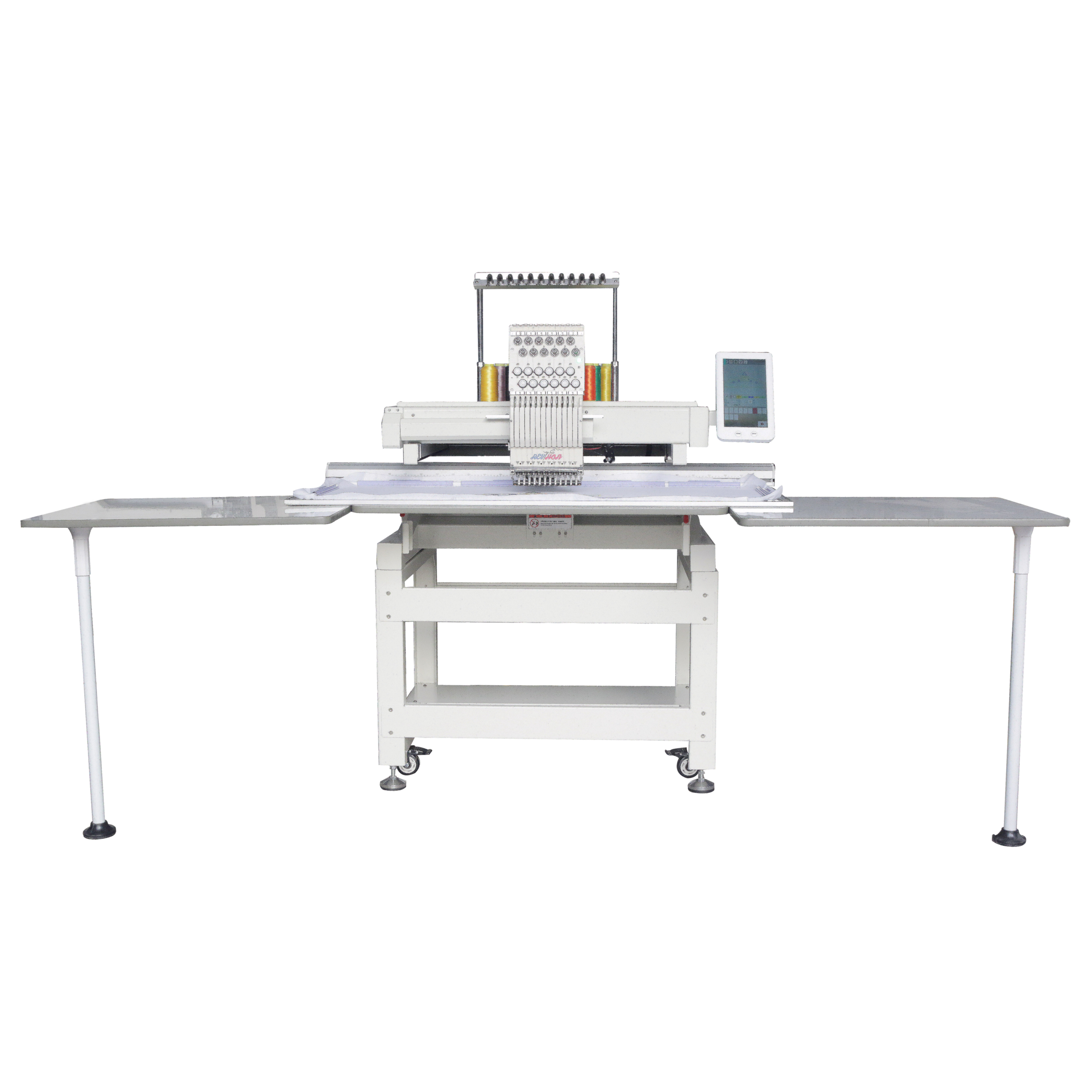
Prosumer single-needle machines possess strict structural limits. The throat space acts as a hard physical barrier to large-area embroidery. This space restricts how much fabric you can physically roll up and push through the machine. When working on a large banner or a thick jacket, the fabric has nowhere to go. It bunches up against the neck of the machine. This friction pulls against the hoop and distorts your design. Single-needle machines work well for hobbyists but fail quickly in a commercial environment demanding large-scale output.
Multi-needle machines offer a distinct cantilevered design. This architecture facilitates much larger native embroidery areas. The machine arm extends outward, keeping the main body far away from the sewing field. Excess fabric hangs freely off the machine arm instead of bunching up. This design eliminates dragging and friction. Operators can maneuver thick duffel bags and winter coats easily. The cantilevered structure is a non-negotiable feature for any serious commercial shop handling bulky items.
You must evaluate the time-cost of large, multi-color designs. Wide files naturally mean longer run times. A full jacket back can easily exceed 80,000 stitches. Multi-needle systems mitigate this significant time delay. They eliminate manual thread changes entirely. The machine automatically switches colors and trims threads. You can set up a large design and let the machine run continuously. On a single-needle machine, an operator must babysit the equipment for hours, swapping threads manually. This automation is vital when scaling oversized work.
When a design exceeds the native embroidery machine embroidery area, operators often split files using digitizing software. We call this the multi-hooping workaround. It seems like a smart way to save money upfront. You slice a large graphic into two or three smaller sections. You stitch the first section, remove the garment, and re-hoop it for the next section. While software makes splitting easy, the physical execution introduces severe operational risks. You are forcing small equipment to do a large machine's job.
Re-hooping large designs guarantees alignment risks. You face an incredibly high probability of misalignment and fabric shifting. If you are off by a single millimeter during the second hooping, the entire design is ruined. Stretch fabrics warp unpredictably when removed and re-clamped. Structured fabrics pucker heavily at the seams where the split designs meet. Achieving perfect registration across multiple hoopings is nearly impossible in a fast-paced shop. These errors result in wasted garments and angry clients.
Manual labor eats into your profit margins rapidly. Masking, marking, and re-hooping take significant time. An operator might spend 20 extra minutes per jacket just trying to align a split design. Calculate this wasted labor against the upfront cost of better equipment. Labor costs over a 12-month period usually exceed the price delta of upgrading to a larger machine. Avoid relying on manual workarounds. Investing in proper hardware eliminates this labor waste and protects your bottom line.
Selecting the right equipment requires aligning your anticipated product mix with machine capabilities. A strategic framework clarifies your exact hardware needs.
Assess the availability of specialized large-area accessories. Large-area embroidery requires robust holding tools to secure heavy materials. Standard plastic hoops often warp or pop open under pressure. Look for manufacturers supporting continuous border frames and sash frames. Oversized magnetic hoops, such as Mighty Hoops, are absolutely vital. They secure heavy winter coats and thick leather seamlessly. Magnetic hoops eliminate hoop burn and reduce operator hand fatigue. Ensure your chosen machine brand natively supports these heavy-duty accessories.
Wide-field machines have specific physical requirements. Factor in the weight and overall facility footprint. Ensure your doorways are wide enough to accommodate the delivery. Table stability is crucial for accurate stitching. Assess operational vibration carefully before making a purchase. Swinging large, heavy garments at high RPMs creates intense kinetic energy. Flimsy stands or tables will shake violently under this load. This vibration compromises stitch quality and accelerates mechanical wear. Your facility must support the robust footprint required by heavy-duty commercial equipment.
Selecting the right machine requires looking directly past the marketed hoop dimensions. You must evaluate the actual sewing field, machine clearance, and pantograph stability. Understanding these mechanical boundaries ensures you purchase equipment capable of handling your specific product mix. A larger hoop means nothing if the machine lacks the motor strength or throat space to support the garment.
Avoid machines demanding constant workarounds for your most profitable items. Prioritize native capability over software-based multi-hooping. Your business cannot scale efficiently if operators spend hours manually re-hooping split designs. Investing in proper large-format equipment protects your margins and guarantees consistent stitch quality across heavy garments.
Take actionable steps before finalizing any commercial purchase. Follow these criteria to verify machine capability:
A: Hoop size refers to the physical dimensions of the outer frame holding the fabric. The embroidery area refers to the strict mechanical limits of the pantograph. The machine's needle can only travel within this specific X/Y field. The true embroidery area is always smaller than the marketed hoop size to prevent the needle from striking the frame.
A: Not natively. You must use digitizing software to split the design into multiple sections. This process requires re-hooping the jacket for each section. Multi-hooping introduces high risks of misalignment, fabric shifting, and puckering. It also significantly increases manual labor time. Upgrading your equipment is a much safer, more profitable solution.
A: It depends on the machine's motor strength and pantograph stability. High-quality commercial machines maintain excellent stitch quality at maximum limits. Prosumer models might struggle. Heavier hoops and garments increase the load on the motor. Weak motors can cause registration drift or skipped stitches at the outer edges of the field.
A: Yes, oversized magnetic hoops are widely available for commercial machines. Brands like Mighty Hoops offer large dimensions specifically designed for heavy materials. These hoops secure thick garments firmly without causing hoop burn. They are essential accessories for efficiently producing jacket backs and oversized appliqués.


