
close
Choose Your Site
Global
Social Media


Views: 0 Author: Site Editor Publish Time: 2026-10-07 Origin: Site


Upgrading your equipment drives necessary business scaling. It represents a major operational shift for any growing shop. However, theoretical maximum speeds often mislead ambitious buyers. Manufacturers heavily advertise peak motor speeds exceeding 1,000 stitches per minute. Yet, actual shop floor yield rarely reflects this peak. Operational bottlenecks cause frequent delays. Frame movements, thread trims, and color changes consume valuable time. You need a realistic framework for calculating true three head embroidery machine output. This article uncovers hidden downtime factors. It helps you evaluate if this configuration matches your commercial volume requirements. We will break down production math, core variables, and real-world implementation risks.
Relying on maximum Stitches Per Minute (SPM) creates flawed ROI calculations. A motor spinning at 1,000 SPM looks impressive on paper. In practice, the needle cannot safely penetrate fabric at this constant velocity. The pantograph must physically move the garment between stitches. Wide satin stitches require slower frame movements. Automatic trims and color changes halt the sewing process completely. Overestimating daily output leads to missed deadlines and frustrated clients.
You must standardize your calculations around practical running speeds. Most experienced operators run their equipment between 700 and 850 SPM. This conservative range minimizes thread breaks. It also preserves stitch quality on complex fabrics. Calculating realistic Garments Per Hour (GPH) requires a structured approach.
Downtime factors account for loading, unloading, and minor thread breaks. Let us examine a baseline scenario. You have a standard 10,000-stitch left-chest logo. You run the equipment at 750 SPM.
Baseline Hourly Output for 10,000-Stitch Design
| Metric | Calculation Step | Result |
|---|---|---|
| Practical SPM | Set by operator for stable production | 750 Stitches Per Minute |
| Cycles Per Hour | (750 × 60) ÷ 10,000 | 4.5 Cycles |
| Gross Output | 4.5 Cycles × 3 Heads | 13.5 Garments |
| Net Output | 13.5 − 25% Downtime Factor | Approx. 10 Garments Per Hour |
Multi-head systems operate on a shared drive shaft. The three heads sew in perfect unison. This creates a distinct mechanical vulnerability. A thread break on one head pauses all three. You lose triple the production time compared to a single-head fault. One struggling needle dictates the pace for the entire run.
We call this the weakest link rule. It makes premium thread mandatory. Proper tensioning becomes critical to your daily yield. Automatic thread trimming speeds also impact cycle times. Older models take several seconds to trim and swap needles. Modern systems execute color changes in fractions of a second. These micro-delays accumulate rapidly over an eight-hour shift.
Your operator dictates ultimate production volume. An idle machine generates zero revenue. Operators must employ a strict hoop-ahead strategy. They must hoop the next three garments while the current cycle runs. When the machine finishes, the operator swaps frames immediately. The equipment should never wait for a freshly hooped item.
Frame types heavily influence your daily shift output. Tubular frames allow fast, fluid loading. Cap frames require more physical manipulation. Changing the entire assembly from tubular mode to cap mode takes considerable time. Grouping your orders by frame type prevents unnecessary mid-shift changeovers.
Poor digitizing destroys commercial output. Inexperienced digitizers often leave excessive jump stitches in their files. The machine must trim the thread at every jump. Each unnecessary trim halts the motor. Badly digitized files force you to lower the running speed.
Design structure directly influences yield. Dense fill stitches allow the machine to run at higher speeds. The frame makes very small movements between needle penetrations. Conversely, long satin stitches require wider frame travel. Simple satin text takes longer to sew than a compact fill shape of the same stitch count.
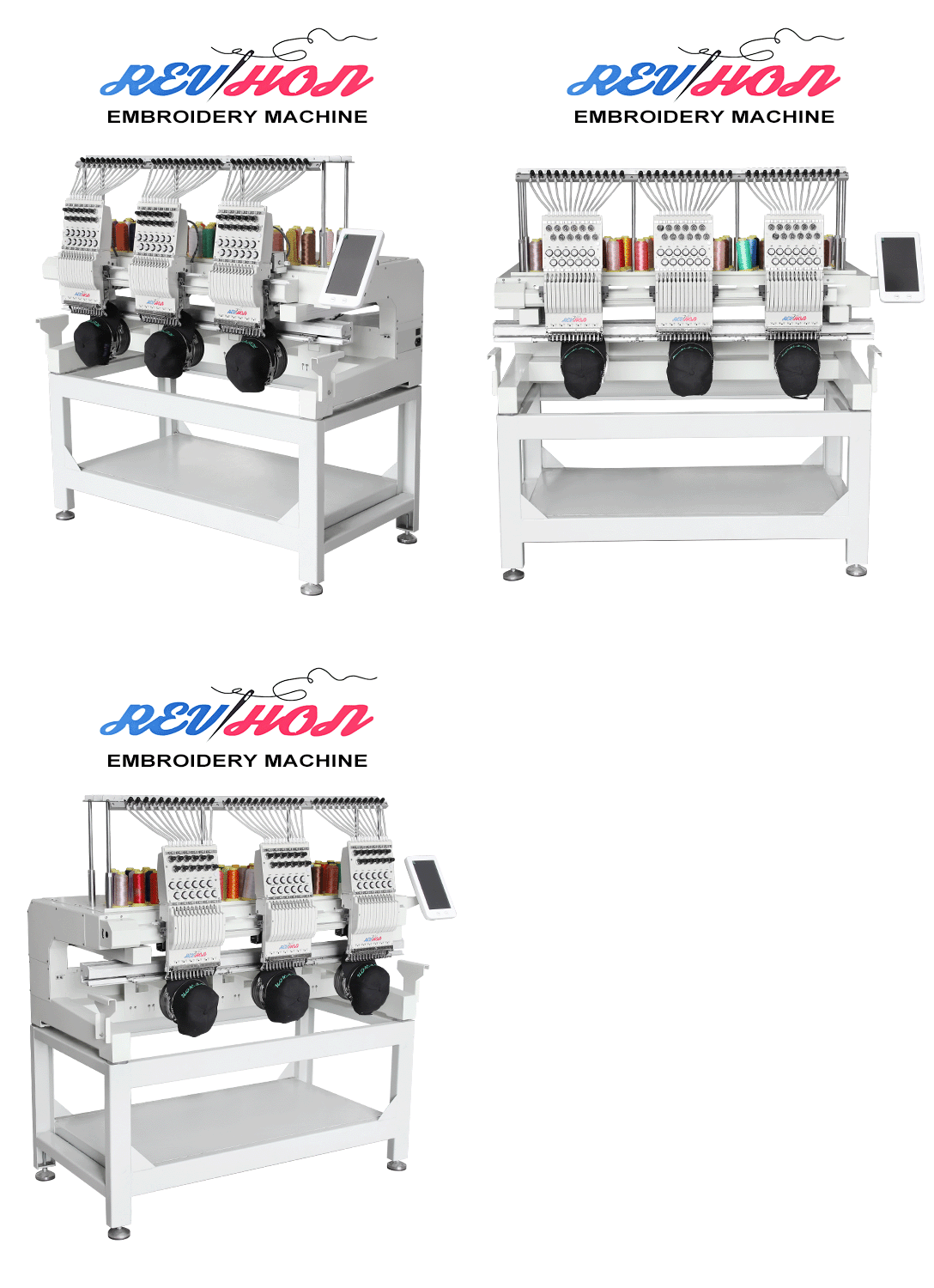
Moving from a single-head unit to a 3-head embroidery machine alters your business model. Single-heads excel at prototyping. They dominate personalization and one-off gifts. However, fulfilling a 30-piece corporate apparel order on a single-head wastes hours. The triple configuration standardizes small-to-medium batch fulfillment. It bridges the gap between retail customization and industrial manufacturing.
You must weigh a 3-head against 4-head or 6-head alternatives. A three-head offers a much smaller physical footprint. It requires less dedicated power infrastructure. This suits shops facing tight space constraints. Larger multi-heads promise higher raw volume. They also carry greater downtime penalties. A thread break on a 6-head stops six garments simultaneously. Complex designs magnify this risk.
Many successful businesses adopt a hybrid shop approach. They pair a multi-head unit for bulk uniform runs. They keep a single-head unit active for localized names and monograms. This strategy maximizes overall facility output. It prevents a single complex hat from tying up your primary production line.
Installing heavier equipment demands physical preparation. Floor weight load becomes a genuine concern. These units weigh several hundred pounds. Standard residential flooring may warp under the focused pressure. Vibration management requires heavy-duty industrial stands. Excessive vibration ruins stitch registration. You must also secure specific voltage and phase power requirements.
Network and software integration streamlines daily operations. You want to avoid USB transfer bottlenecks. Modern digitizing software pushes designs directly to the terminal via a local network. This eliminates manual file hunting. It ensures the operator sews the correct design revision every time.
Maintenance overhead increases significantly. You now manage three distinct bobbin cases. You must calibrate three sets of upper thread tensions. Hook timing complexities grow compared to single-head units. Strict lubrication schedules prevent catastrophic mechanical failures. You must dedicate time each week for deep cleaning and oiling.
Drive architecture determines long-term reliability. Evaluate servo motors versus stepper motors. Servo motors provide smoother acceleration. They handle continuous, multi-shift durability far better than cheaper stepper motors. They reduce internal vibration at high speeds.
Pantograph clearance dictates your product catalogue. Match the maximum sewing field to your most common output requirements. A small X/Y field restricts jacket back designs. Make sure the pantograph clears the physical chassis when moving to extreme edges.
Assess the cap system stability carefully. Hats generate the highest volume of registration errors. A flimsy 270-degree cap system bends during operation. This causes needles to deflect and break. A rigid cap driver ensures clean lettering on curved surfaces.
When you shortlist a 3-head embroidery machine, prioritize vendor support. Local technician access minimizes disaster scenarios. Domestic parts inventory keeps your business running. Waiting three weeks for an overseas replacement board destroys your production schedule.
True output remains a byproduct of machine mechanics, operator workflow, and intelligent digitizing. You cannot rely on maximum motor speeds to project your daily yields. Managing thread breaks and hooping efficiency dictates your success. Understanding the synchronized nature of multi-head equipment helps you avoid costly delays.
Take proactive steps before finalizing your purchase. Request a live demonstration from the vendor. Insist they run your specific, customized production file. Do not accept a pre-optimized manufacturer test file. Time the actual cycle from start to finish. This verifies real-world performance against your commercial expectations.
A: Based on a standard 7,000-stitch design running at 750 stitches per minute, the machine completes roughly 6.4 cycles hourly. Multiplied by three heads, gross output is 19 garments. Factoring in 20% downtime for loading and unloading, realistic net output averages 15 shirts per hour.
A: One skilled operator usually manages a single 3-head machine efficiently. Workflow dynamics require continuous pre-hooping. While the machine sews the current batch, the operator hoops the next three garments. This overlap prevents idle time and maximizes daily production.
A: No. Standard multi-head machines share a single central drive shaft and pantograph. They sew the exact same design concurrently on all heads. The frame moves all garments together. You cannot sew distinct logos on different heads at the same time.
A: An average unit requires a footprint of roughly 6 feet wide by 3 feet deep. You must also add at least 3 feet of clearance around the machine. This allows unrestricted pantograph movement and gives the operator comfortable access for hooping and maintenance.


