
close
Choose Your Site
Global
Social Media


Views: 0 Author: Site Editor Publish Time: 2025-10-31 Origin: Site


When customers or small business owners begin exploring embroidery production, one of the most common questions is: how much is embroidery per 1,000 stitches? While there is no single answer that fits every order, understanding how this pricing works helps buyers and manufacturers communicate better, manage costs, and optimize efficiency. At Zhuji Qihong Electro-Mechanical Co., Ltd., we specialize in computerized embroidery machines designed to make each stitch more precise and economical. Knowing how embroidery pricing is calculated allows you to appreciate how professional-grade computerized embroidery equipment helps reduce production costs while maintaining consistent quality.
Across the embroidery industry, pricing is generally calculated per 1,000 stitches. On average, the rate can range between a few cents to a few tenths of a dollar per 1,000 stitches depending on the region, order size, and complexity of the design. For example, simple logo embroidery with a clean stitch pattern may cost less per unit than dense multi-color designs with frequent thread changes.
The variation exists because embroidery is a mix of art, technology, and labor. Each embroidery project involves multiple steps — digitizing the design, setting up the machine, selecting threads, hooping garments, and finishing. Businesses using advanced multi-head machines or automated production lines can handle bulk orders faster and more efficiently, thus lowering their per-stitch rate.
It’s also important to understand that embroidery pricing reflects the value of professional expertise. Experienced machine operators know how to balance speed and tension, preventing thread breakage and fabric damage — issues that can increase production costs. Therefore, a slightly higher price per 1,000 stitches often means higher consistency and fewer reworks, resulting in a better final product.
In essence, while the per-1,000-stitch number offers a quick benchmark, it should always be seen as a flexible guideline influenced by real production conditions and machine capability.
Understanding what affects embroidery pricing helps both buyers and sellers make informed decisions. Here are the key elements that determine how much embroidery costs per 1,000 stitches:
The number of stitches in a design is the biggest pricing factor. A dense pattern with high stitch count takes longer to run and requires more thread. Complex shapes, shading, and gradient designs also require more time from both the digitizing stage and machine operation. Commercial embroidery machines with computer control systems can handle intricate designs with better accuracy, but the time cost per design still matters for pricing.
Simpler designs like logos with clean borders and fewer color changes tend to have lower stitch density and thus lower cost per 1,000 stitches. On the other hand, designs that require layering, overlapping stitches, or specialty threads take more machine time and increase thread consumption.
Different thread materials have different prices. Metallic threads, special color shades, or thicker polyester threads cost more than standard rayon threads. Furthermore, frequent thread changes between colors increase the machine’s idle time and reduce efficiency.
Modern computerized embroidery machines from Zhuji Qihong Electro-Mechanical Co., Ltd. are equipped with automatic thread trimming and color-changing functions. These intelligent systems shorten production time and stabilize the per-1,000-stitch cost by minimizing waste and manual interruptions. Advanced control systems also help maintain perfect thread tension and prevent thread breakage, reducing both material consumption and downtime.
Besides thread, several other materials affect embroidery costs. Backing or stabilizer materials support the fabric during stitching and vary in price depending on thickness and type. Digitizing fees — converting artwork into machine-readable embroidery files — are typically charged separately for new designs.
Setup time, including hooping and alignment, also plays a role. Single-head machines require more manual handling, while multi-head models can embroider several garments at once, reducing labor time per piece. The level of automation in the equipment directly influences overall pricing efficiency.
Bulk orders almost always bring the per-1,000-stitch cost down. This is because setup and digitizing costs are spread across a larger number of garments. Businesses using multi-head embroidery machines benefit from parallel production — the same design stitched simultaneously across several heads.
Zhuji Qihong’s multi-head and high-speed embroidery machines are engineered precisely for this purpose. They feature advanced computer control systems that ensure stable quality even under long-hour operation, providing significant savings for bulk orders. Automation also reduces the need for manual supervision, allowing operators to handle multiple machines or tasks efficiently.
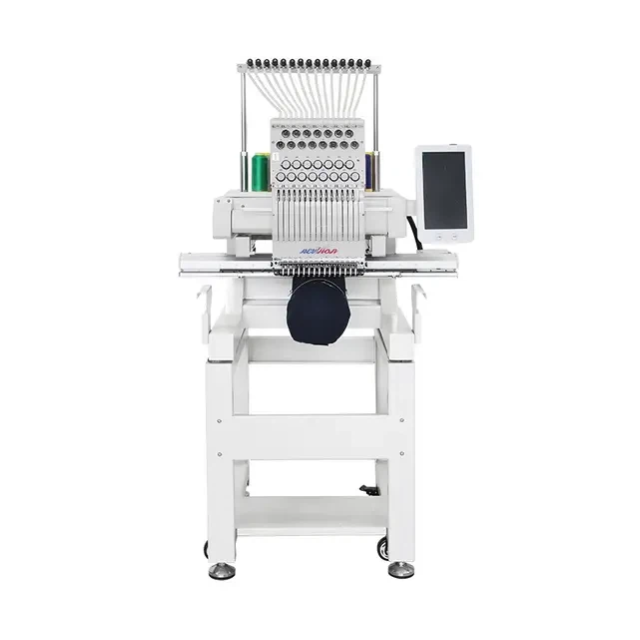
The machine you use has one of the greatest impacts on your embroidery pricing model. A commercial-grade machine operates faster, handles more fabric types, and ensures consistent results compared to home or single-head units.
Multi-head commercial embroidery machines can work on multiple garments simultaneously, drastically reducing cost per piece. They are designed to maintain consistent tension, accurate thread trimming, and high-speed operation. In contrast, smaller hobbyist machines are more suitable for low-volume work but take more time and effort for each item, increasing the per-1,000-stitch cost.
At Zhuji Qihong Electro-Mechanical Co., Ltd., our computerized embroidery machines combine speed and stability. Each unit features intelligent controls, automatic color change, thread detection, and error correction, minimizing downtime and production waste. This efficiency translates directly into lower per-stitch costs for embroidery businesses.
Our machines are also built for long-term durability. With a sturdy frame and precision components, they deliver stable operation even at high speeds, reducing maintenance costs. Over time, this reliability significantly lowers the cost of ownership, allowing embroidery workshops to maintain competitive pricing without sacrificing quality.
To understand how embroidery costs are distributed, let’s consider a simple percentage-based example for 1,000 stitches. While the exact currency values may vary, the relative proportions often remain similar across manufacturers:
Thread and materials: 15–20%
Labor and setup: 30–35%
Machine operation and maintenance: 20–25%
Overhead (electricity, rent, etc.): 10–15%
Profit margin: 10–15%
In this breakdown, labor and setup form the largest cost component, which means efficient machine operation and automation can lead to significant savings. High-speed, multi-head embroidery machines reduce labor time per design, effectively lowering the overall cost per 1,000 stitches while maintaining the same product quality.
Additionally, energy-efficient models consume less power during continuous operation, further minimizing overhead. Advanced computerized controls also reduce rework, helping embroidery businesses maintain profitability while offering clients competitive rates.
Both buyers and sellers benefit from understanding how stitch-based pricing works. Here are some practical suggestions for each side of the embroidery business:
Always estimate the stitch count accurately before quoting a price.
Include setup fees or digitizing costs transparently to avoid misunderstandings.
Consider offering volume-based discounts to attract larger orders.
Use multi-head and automated embroidery machines to maximize productivity.
Bundle services, such as design digitizing plus embroidery, for added value.
Regularly maintain machines to ensure steady speed and reduce unplanned downtime.
Request an estimated stitch count before placing your order to understand total cost.
Ask for sample sew-outs to check design density and stitch quality.
Compare quotes based on the same stitch count and similar design complexity.
Evaluate not only the price but also turnaround time and consistency.
Work with suppliers that use advanced computerized machines to ensure quality and efficiency.
Understand that very low prices might indicate low stitch density or reduced durability.
Embroidery pricing is not just about numbers — it reflects technology and craftsmanship. Using high-performance, automated machines allows embroidery shops to deliver consistent results in less time. Zhuji Qihong Electro-Mechanical Co., Ltd. designs its embroidery machines to meet these professional demands.
Our range includes single-head, double-head, and multi-head models suitable for flat embroidery, towel embroidery, and cap embroidery applications. Each model features a robust frame for stability, intelligent control software for design accuracy, and high-speed motors for continuous production. These advantages allow users to produce more garments per hour at a lower cost per 1,000 stitches, making the equipment ideal for both startup and established embroidery businesses.
The answer to how much is embroidery per 1,000 stitches depends on many variables — design complexity, materials, labor, and machine efficiency. However, one factor remains constant: using advanced computerized embroidery machines dramatically reduces production time and ensures precise, professional results.
At Zhuji Qihong Electro-Mechanical Co., Ltd., we are dedicated to helping embroidery businesses enhance productivity and profitability through reliable, high-speed machines built for long-term performance. If you want to learn how our commercial embroidery solutions can lower your embroidery production cost, contact us today to discuss your specific requirements and receive a detailed quote tailored to your business needs.


