
close
Choose Your Site
Global
Social Media


Views: 0 Author: Site Editor Publish Time: 2026-09-03 Origin: Site


Scaling a commercial embroidery business often reveals a frustrating bottleneck. You hit maximum daily capacity but lack the capital or space for massive multi-head industrial setups. Overcoming this hurdle requires moving beyond basic production limits without over-leveraging your operation. Expanding requires precision.
We must define "capacity" beyond mere machine speed. True production capacity encompasses daily volume limits, realistic turnaround times, and operator workflow efficiency. It measures how quickly you finish entire jobs, not just how fast needles move. You need to align equipment output directly to order demands.
This article provides a rigid, math-based evaluation framework. You will learn how to match your project’s actual daily output requirements to precise machinery standards. We will examine essential metrics, calculate real-world downtimes, and emphasize proper supplier support. You can then confidently diagnose your current ceiling and select the ideal commercial solution for sustainable growth.
Transitioning from a single head embroidery machine to a 2-head system effectively doubles output without doubling labor or footprint.
Evaluating 2-head embroidery machine specifications requires looking past theoretical maximum speeds (RPM) and calculating realistic stitch-per-minute averages that include hooping and thread change downtimes.
Choosing the right 2-head computerized embroidery machine manufacturer relies heavily on post-sale SLA, parts availability, and training infrastructure, not just upfront pricing.
Higher needle counts (e.g., 15 or 20 needles) reduce thread-change bottlenecks for complex designs but require justification through order complexity.
Recognizing the exact moment to upgrade requires monitoring your daily volume thresholds. A single head embroidery machine acts as an excellent starting point. However, it quickly becomes a growth liability under sustained commercial pressure. You hit a ceiling when daily orders consistently exceed 20 to 25 garments requiring complex, multi-color designs. Pushing equipment past this volume forces rushed setups, skipped maintenance, and inevitable quality drops.
Labor bottlenecks also signal the need for equipment expansion. Analyze your operator's time-in-motion. If an operator stands idle while a single head finishes a 15-minute run, you lose valuable labor efficiency. Running two synchronized heads fundamentally shifts this dynamic. An operator preps the next batch, hoops garments, and trims backings during the active run cycle. This parallel workflow maximizes labor return on investment. The operator constantly moves, prepping or finishing, rather than waiting.
Specific project scopes strictly demand synchronized dual-head output. Consider these common commercial scenarios:
Corporate Uniform Contracts: Delivering 100 identically branded polos requires tight consistency. Dual heads ensure two shirts finish perfectly matched in tension and color simultaneously.
Bulk Cap Orders: Hats often involve continuous, repetitive runs. A single head drags a 50-piece cap order across an entire shift. Dual heads cut this time in half.
Rush Event Merchandise: Event organizers demand tight turnarounds. Single heads cannot compress 48-hour delivery windows without excessive overnight shifts.
Common Mistake: Many shop owners buy a second standalone machine instead of an integrated multi-head system. Managing two separate control panels, loading files twice, and networking separate units wastes time. A unified multi-head system synches the process perfectly.
You must scrutinize hardware specifications to understand actual floor capabilities. Reviewing 2-head embroidery machine specifications means translating technical jargon into daily production advantages. Manufacturers offer varying needle configurations, usually 12, 15, or 20 needles per head. Do not view higher needle counts simply as expanded color palettes. Frame them primarily as downtime-reduction features.
Every manual thread change stops production. If your core project involves frequent custom colors across different orders, a 15 or 20-needle configuration keeps your most popular threads permanently loaded. You avoid re-threading the machine multiple times a day. If your shop only runs basic 3-color corporate logos, a 12-needle unit provides sufficient capacity. Match the needle count directly to your design complexity.
Embroidery field size constraints significantly impact product versatility. Standard flat fields often measure roughly 400mm x 450mm. This size handles jacket backs, large totes, and standard left-chest logos flawlessly. However, if your project relies heavily on caps, you need specialized wide cap frames. Ensure the machine's mechanical limits fit the physical dimensions of your most profitable product line. A massive sewing field offers no value if you exclusively embroider visors and beanies.
Control panels and memory processing dictate daily operational speed. Older or cheaper models struggle to process complex digitized files. Look for highly responsive touchscreen interfaces. You need substantial internal memory to hold hundreds of large stitch-count files simultaneously. Slow processors cause machine lag during color sequence setups or design tracing. High-speed memory processing keeps operators moving quickly between distinct jobs.
Best Practice: Always test the interface responsiveness before purchasing. Navigate menus, split files, and rotate designs on the screen. If the interface lags or freezes during a simple rotation, it will frustrate operators daily.
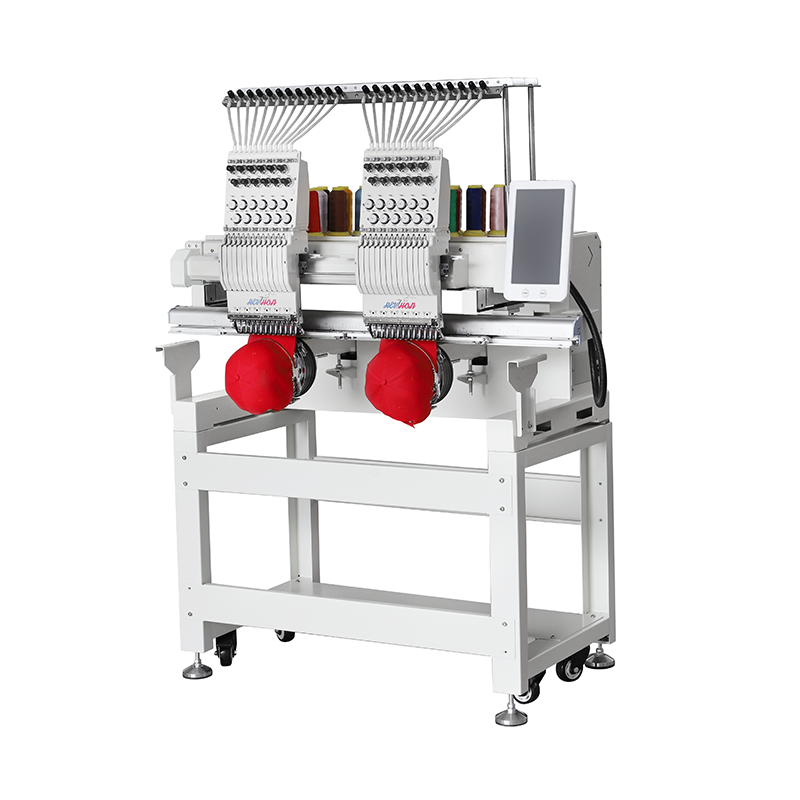
Many buyers rely on misleading marketing metrics. A manufacturer might advertise a theoretical maximum speed of 1000 to 1200 stitches per minute (SPM). Running equipment at absolute maximum capacity causes excessive thread breaks, inconsistent tension, and rapid part wear. A realistic running speed hovers between 750 and 850 SPM. You must base your output projections on this functional average to guarantee high-quality results.
The calculation must also integrate the downtime formula. Machines do not run continuously for eight hours. You must factor in 15% to 20% downtime per shift. This buffer accounts for manual hooping, bobbin changes, thread trimming, file loading, and inevitable thread breaks. Failing to calculate downtime creates impossible delivery promises for your clients.
Let us look at an output projection example. We will use a standard 10,000-stitch corporate logo. We apply a verifiable formula: (Stitches per design ÷ Average SPM) + Hooping/Changeover Time. We then apply this to a 2-head embroidery machine operating simultaneously.
Projected Output Shift Comparison
Metric | Single Head Production | Dual Head Production |
|---|---|---|
Design Size | 10,000 stitches | 10,000 stitches |
Running Speed | 800 SPM | 800 SPM |
Run Time per Cycle | 12.5 minutes | 12.5 minutes |
Changeover/Hoop Time | 3 minutes | 3 minutes |
Total Time per Cycle | 15.5 minutes | 15.5 minutes |
Garments per Cycle | 1 garment | 2 garments |
8-Hour Shift Output (Est.) | Approx. 26 garments | Approx. 52 garments |
As the math shows, output scales perfectly while labor time remains static. One operator manages the 15.5-minute cycle for both heads. During the 12.5-minute active run time, they prepare the next two garments. You effectively double production without hiring a second operator or buying two separate machines.
Integrating a dual-head system requires careful site preparation. A standard single head embroidery machine fits on a sturdy workbench. A commercial multi-head unit demands dedicated floor space. You must detail the exact spatial footprint required for the machine itself, plus a minimum 3-foot clearance perimeter for operator maneuverability. Cramped workspaces lead to hooping errors and safety hazards.
Electrical requirements also change significantly. Discuss standard power requirements with your electrician before delivery. While some smaller dual models run on 110V standard outlets, heavy-duty commercial units often require dedicated 220V single-phase lines. Never run industrial equipment on shared circuits. You must install industrial-grade surge protection. Power fluctuations can instantly fry expensive motherboards or corrupt internal memory files.
Consider weight and floor integrity. Commercial multi-head setups weigh hundreds of pounds. You cannot place them on weak flooring or standard tables. They require heavy-duty, vibration-dampening stands. Excessive vibration causes needle deflection, registration errors, and premature mechanical wear. Ground-floor installation on concrete remains the ideal scenario. If you must install on a second floor, verify structural load limits first.
Site Prep Checklist:
Measure doorways to ensure the crated machine fits inside.
Install dedicated electrical circuits with proper grounding.
Verify floor load capacity and level the surface completely.
Ensure adequate overhead lighting for detailed thread color matching.
Address the operator learning curve. Transitioning staff to manage a multi-head workflow involves specific software and hardware training. Operators must learn how to assign needles across multiple heads, troubleshoot localized error codes, and manage dual-hooping alignment. If one head experiences a thread break, the operator must know how to back up both heads simultaneously to maintain synchronization. Build a two-week training buffer into your integration schedule.
Purchasing commercial equipment involves buying into an ecosystem. You must evaluate warranties carefully. Guide your purchasing team to read the fine print regarding electronic components versus mechanical parts. Many brands offer a "5-year warranty," but this often covers only major structural castings. Electronic panels, rotary hooks, and tensioners usually carry much shorter coverage windows. Understand exactly what fails most often and how it gets replaced.
Service Level Agreements (SLAs) dictate your actual uptime. Evaluate every 2 head computerized embroidery machine manufacturer based on their technical support response times. If your machine goes down mid-order, waiting 48 hours for an email reply destroys client relationships. Ask potential suppliers about the availability of localized technicians. Can they dispatch a certified mechanic to your shop, or must you ship heavy components across the country?
Parts availability presents a massive supply chain risk. Buying cheap, white-label machines often traps you in proprietary parts nightmares. If a specialized motor burns out and the factory overseas stops producing it, your machine becomes obsolete. A credible 2-head embroidery machine supplier guarantees rapid shipping for consumable parts. They should stock rotary hooks, needles, motherboards, and trimmers domestically.
Common Mistake: Choosing a supplier based entirely on upfront pricing ignores the reality of commercial wear and tear. A machine saving you $2,000 at checkout will cost you $10,000 in lost orders if replacement parts take three weeks to clear customs.
Shortlisting the right equipment requires aligning your daily stitch volume and design complexity with specific hardware. A robust dual-head system tackles larger orders swiftly. You must choose appropriate needle counts to minimize thread changeovers and select field sizes that accommodate your most profitable products.
Investing in commercial embroidery machinery acts as a long-term ecosystem purchase. The machine remains profitable only when it runs consistently. Uptime drives your success. This dictates the absolute necessity of choosing a highly vetted manufacturing partner offering exceptional post-sale support, training, and rapid parts delivery.
Take action today by conducting a localized time study of your current orders. Track your average stitch counts, daily garment outputs, and operator idle times over a standard week. Use this precise data to finalize your specification requirements. You can then confidently upgrade your capacity and secure larger, more lucrative commercial contracts.
A: Yes. One skilled operator can easily manage a dual-head system. The synchronized process allows the operator to prep, hoop, and trim the next batch while the machine actively stitches the current order. This maximizes workflow and eliminates idle waiting periods common with single-head setups.
A: You should allocate approximately 6 to 8 feet of width for the machine and stand. Add a minimum 3-foot clearance perimeter around the entire unit. Operators need this space for comfortable hooping, loading, and maintenance without risking safety or restricting physical movement.
A: No. Standard commercial digitizing software generates formats like .DST or .DSB, which dual-head machines read perfectly. The primary difference lies in the machine's onboard control panel, which automatically duplicates and synchronizes the single digitized file across both operating heads simultaneously.
A: A busy shop operating five days a week can often recover the equipment output value within 8 to 14 months. By effectively doubling daily production capacity without increasing hourly labor, shops accept larger wholesale contracts and expedite turnaround times, rapidly accelerating production-based revenue recovery.


