

close
Choose Your Site
Global
Social Media


Views: 0 Author: Site Editor Publish Time: 2026-08-30 Origin: Site


Purchasing commercial embroidery equipment is a high-impact capital expenditure for expanding shops. Startups and home businesses also rely heavily on this critical decision. It directly dictates your production capacity and daily efficiency. The modern market feels incredibly saturated today. Buyers face countless imported and domestic options. Manufacturers often boast similar top-line numbers on their brochures. However, they present drastically different operational realities when put to work on the shop floor. You might find machines looking identical but performing leagues apart.
Our goal here is straightforward. We want to provide an objective, manufacturer-agnostic framework. It will help you evaluate technical capabilities and assess vendor credibility. We strip away the marketing jargon to focus on what matters. You will learn how to match machine specifications directly to real-world business requirements. By the end of this guide, you will know exactly how to pinpoint the right equipment for your production line without costly guesswork.
Evaluating a single head embroidery machine requires looking past theoretical stitch speeds to focus on actual output consistency and vibration control.
Core specifications like embroidery field size and needle capacity dictate product versatility (e.g., caps, jackets, flats).
A high quality single head embroidery machine is defined as much by its digital ecosystem and tension systems as its physical footprint.
The credibility of your single head embroidery machine supplier—specifically their post-sale support, training, and parts inventory—is critical to preventing expensive operational downtime.
You cannot choose the right equipment without first defining your exact workflow. Buyers often make the mistake of buying too much or too little machine. We must start by mapping your specific business case directly to hardware requirements.
Defining the Business Case
Different garments demand drastically different mechanical capabilities. You must identify your target product types before comparing models.
Caps and Headwear: These require a specialized cap driver. They also need a wide rotational degree to stitch ear-to-ear.
Heavy Jackets and Bags: Thick materials demand strong needle penetration. They require high clearance under the needle block.
Standard Flats and Polos: These are easier to hoop. They rely heavily on fast, consistent stitching over long runs.
Your business case defines your physical constraints. You must know what you plan to sew before checking spec sheets.
Throughput Realities
You must calculate realistic daily output versus manufacturer maximums. A brochure might claim a top speed of 1,200 stitches per minute (SPM). However, you will rarely operate at this maximum speed continuously. Actual production speed fluctuates. The machine slows down for complex curves, thread trims, and color changes. Real-world continuous operating speed usually hovers between 700 and 850 SPM. You should base your production projections on these realistic averages. This prevents you from overpromising delivery times to your clients.
The Scalability Question
You must decide if a single head embroidery machine is your best long-term constraint. Single-head models offer incredible flexibility. They excel at custom, low-volume orders. You can set up a complex jacket back quickly. They allow you to pivot seamlessly between different garment types. However, multi-head machines become mathematically necessary for massive, identical runs. You must evaluate your typical order size. A single-head unit handles batches of 10 to 50 items beautifully. If you routinely land orders for 500 identical caps, you might eventually need multi-head scalability.
You must dig into the granular details of the hardware. The right single head embroidery machine specifications ensure your shop runs smoothly. Let us break down the most impactful technical features.
Needle capacity directly impacts your downtime. You will see models offering either 12 or 15 needles. A 15-needle setup gives you three extra color options per run. This sounds minor, but it saves immense amounts of time. You avoid stopping the machine to re-thread spools for complex, colorful logos. It also means you can keep common colors permanently threaded. You might leave black, white, navy, and red on the machine constantly. More needles equate to less manual intervention and higher daily efficiency.
The embroidery field size dictates your design limitations. You must compare pantograph limits carefully. A standard field might measure 14 by 14 inches. This works fine for left-chest logos and standard hats. However, full jacket backs require much larger fields. You might need a 20 by 14-inch clearance. Furthermore, physical clearance around the cylinder arm matters deeply. Bulky items like duffel bags need space to drape. If the machine body sits too close to the sewing arm, you cannot load large bags. Always measure your largest planned item against the machine’s physical throat space.
We already discussed theoretical maximums versus realistic speeds. But the motor type driving those stitches matters even more. You want equipment powered by servo motors rather than basic stepper motors. Servo motors provide superior dynamic control. They accelerate and decelerate smoothly. This precision prevents missed stitches on heavy fabrics. Servo motors also run significantly quieter. They experience far less long-term mechanical wear. A heavy-duty servo system ensures your design registration remains flawless, even after thousands of operational hours.
Specification Comparison Chart
Feature | Entry-Level Standard | Commercial Standard | Impact on Production |
|---|---|---|---|
Needle Count | 6 to 10 Needles | 12 to 15 Needles | Reduces re-threading and limits manual downtime. |
Field Size | 8" x 8" | 14" x 14" or larger | Dictates ability to sew full jacket backs and large banners. |
Motor Type | Stepper Motor | Servo Motor | Improves stitch precision, lowers noise, and extends machine life. |
Cap Driver Range | 180 Degrees | 270 Degrees | Allows seamless ear-to-ear stitching on modern headwear. |
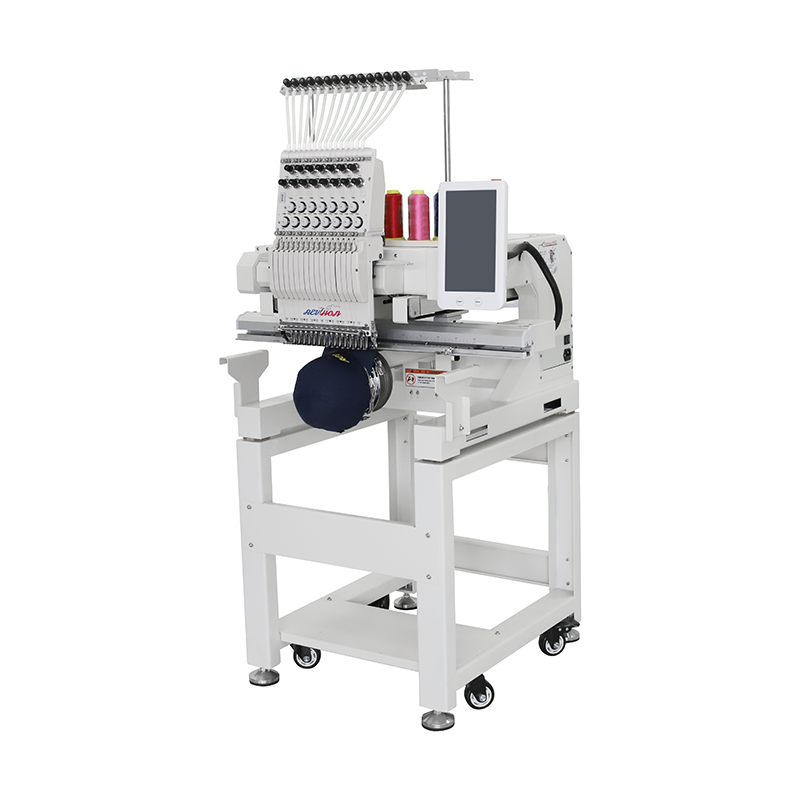
Beyond raw numbers, the physical and digital build quality dictates longevity. You need a high quality single head embroidery machine to avoid daily frustrations. Let us examine the hallmarks of premium construction.
Structural Integrity
Weight is often an indicator of quality in commercial embroidery. You should look for a heavy-duty metal chassis. Lightweight plastic builds vibrate aggressively at high speeds. Severe vibration causes poor design registration. Outlines will drift away from their color fills. A heavy, rigid frame absorbs the kinetic energy of the moving pantograph. This vibration reduction keeps your stitches crisp and accurate.
Tension Systems and Thread Management
Proper thread tension defines your final product quality. You must evaluate the tensioning system carefully.
Automatic Thread Trimming: The machine must cut jump stitches cleanly. Manual trimming wastes hours of labor.
Thread Break Detection: A reliable upper and lower thread sensor is mandatory. It stops the machine instantly if a thread snaps. This prevents ruined garments.
Smooth Thread Paths: Ceramic eyelets and precise tension knobs prevent "bird-nesting" beneath the needle plate.
Control Panel and Digital Ecosystem
You interact with the control panel constantly. Assess the user interface (UI) and user experience (UX) of the touchscreen. Is it intuitive? Can you rotate, scale, and trace designs easily? Memory capacity also plays a large role. The machine should store millions of stitches internally. Furthermore, you must verify universal file format compatibility. The industry standard formats are .DST and .EXP. Universal compatibility ensures you never get locked into one proprietary software vendor.
Compliance and Safety
Safety certifications protect your business. You must check for industry-standard electrical certifications like CE or UL ratings. Uncertified machines pose severe fire risks. Additionally, look for prominent emergency stop mechanisms. A large, accessible E-stop button lets you halt production instantly if a garment snags or a hoop slips.
Even the best hardware requires support. The credibility of your single head embroidery machine supplier determines your long-term success. A machine sitting idle waiting for parts generates zero revenue.
Technical Support SLAs
You must understand their Service Level Agreements (SLAs). How fast do they respond to tickets? You need definitive response times. Furthermore, verify the availability of domestic technicians. Calling a support line and facing massive time-zone differences kills productivity. Look for suppliers offering robust remote troubleshooting capabilities. They should be able to guide you through control panel diagnostics via video call.
Warranty Terms
You must deconstruct the warranty limitations. Do not settle for a blanket "five-year warranty" claim. You need to differentiate the coverage tiers. Typically, major structural parts receive long warranties. However, labor coverage might only last one year. Electronic components, like the main motherboard or touchscreen, usually have entirely different, shorter terms. Read the fine print to know exactly what protections you carry.
Choosing the right commercial equipment shapes your business trajectory. The best choice always balances technical specifications with reliable vendor support. Assess your specific garment needs, verify the hardware capabilities, and heavily scrutinize the vendor's post-sale infrastructure.
Your next actionable step is straightforward. Create a standardized shortlist matrix mapping your exact needs. Then, contact your top vendors. Do not rely on their pre-optimized test files during a demonstration. Always request physical or virtual demonstrations using your specific, custom design files. This proves the machine can handle your actual workload. Take your time, ask hard questions, and invest in a system designed to scale with your ambition.
A: A high-quality commercial machine typically lasts 7 to 10 years or more under standard daily use. This lifespan depends heavily on strict routine maintenance. Oiling the rotary hook daily, greasing the pantograph rails, and scheduling annual professional servicing dramatically extends the equipment's operational life.
A: Yes, they are highly versatile. You simply switch out the hooping apparatus. For hats, you attach a specialized cap driver to the cylinder arm. This driver rotates the curved surface under the needle. For flat garments, you remove the cap driver and use standard flat hoops.
A: Most commercial models operate between 65 and 75 decibels. This is roughly the noise level of a standard vacuum cleaner. While manageable in a home, the rapid needle punching creates noticeable floor vibration. Home business owners often place anti-vibration mats under the heavy stand to reduce noise.
A: Buying new provides comprehensive warranty security, modern software integration, and structured onboarding. Buying used offers a steep depreciation discount. If you buy used, you must vet the refurbished model carefully.


