

close
Choose Your Site
Global
Social Media


Views: 0 Author: Site Editor Publish Time: 2026-09-30 Origin: Site


Misaligning your production schedule with your equipment’s physical capabilities is the fastest way to erode margins. Relying purely on digital stitch estimates creates massive operational blind spots across your factory floor. Physical hardware constraints ultimately dictate real-world factory output and profitability.
B2B buyers and production managers often calculate Minimum Order Quantity (MOQ) and lead times based on stitch counts alone. They frequently ignore the physical constraints and setup efficiencies dictated by the machine's actual working area. This common oversight ruins production schedules rapidly. It leads directly to delayed orders, increased labor costs, and intensely frustrated clients.
To protect profitability and guarantee delivery dates, decision-makers must act strategically. You must build production forecasting models directly around spatial equipment constraints. You must also account for daily operational realities in your specific facility. We will explore how to optimize minimum orders based on machine dimensions. You will also discover how to forecast highly realistic lead times.
Physical space constraints fundamentally dictate your operational unit economics. Your available sewing field limits how quickly operators can process garments on the floor. A larger continuous embroidery field reduces the need for constant re-hooping during massive designs. This mechanical advantage directly drives down active labor hours per unit produced.
We see clear tradeoffs when evaluating equipment sizing strategies. Oversized beds inherently demand much longer setup times. They require heavier framing systems to keep garments stable. This creates massive inefficiencies for processing small-batch custom orders. Operators often spend more time moving heavy frames than the machine spends sewing. Operator fatigue also increases rapidly when handling massive tubular hoops all day.
Evaluating your embroidery machine working area is absolutely essential for profitable daily scheduling. Consider a very common implementation reality facing many shop owners today. You load a massive multi-head machine to process a simple five-piece order. You will lose money purely on setup and staging overhead.
The time spent hooping massive jackets far exceeds the brief active stitching time. You pay operators for staging garments, not for actual production. Profit margins disappear entirely during these extended setup windows. Therefore, aligning job sizes directly to physical machine dimensions is non-negotiable for sustained success. Small jobs belong strictly on compact frames. Massive jobs require expansive beds to remain profitable.
You must calculate an optimal MOQ by balancing overhead costs against your physical hardware capacity. Review your embroidery machine working area specifications carefully before quoting or pricing jobs. Digitizing artwork takes considerable time. Thread tensioning requires skilled labor. We must absorb these fixed costs safely across the total order volume.
MOQ scales linearly based on your available head count. This assumes the sewing field comfortably supports your specific garment size. A six-head unit should naturally process orders in multiples of six. Running three items on a six-head unit wastes half of your potential hourly capacity.
Consider this simple cost-to-volume mathematical framework for your facility. Assume standard hoop placement takes exactly three minutes per garment. You must calculate the minimum run length required to dilute this specific labor cost effectively. Setup labor should ideally remain under five percent of your total unit price. If staging takes too long, your MOQ must increase to maintain baseline profitability.
Facility managers must conduct honest risk assessments regularly. Do not set artificially low MOQs on large-format industrial equipment. You cannot implement low minimums without aggressively adjusting your pricing tiers. If you leave large heads idle, you must charge the client for unutilized machine time. Otherwise, your overhead will consume your entire profit margin before the job finishes.
Accurate lead times require a strict, uncompromising time allocation breakdown. Every industrial embroidery machine operates on a highly specific timeline based on its mechanics. Software stitch estimates only tell one-third of the actual production story.
The manual hooping process remains your primary daily production bottleneck. Larger spatial areas often require specialized, heavier framing systems to maintain tension. These bulky systems add crucial minutes to the setup of each individual garment. Heavy pantographs simply move slower than lightweight ones. You cannot ignore this physical reality when planning tight client deadlines.
You must maintain highly transparent assumptions regarding machine speed. Theoretical stitch speed rarely translates into actual daily production output. A machine rated for 1000 RPM usually averages much lower functional speeds. Thread breaks happen daily and halt production entirely. Complex color changes force the needle bar to stop completely.
Furthermore, wide frame movements mechanically limit how fast motors can drive the pantograph safely. Pushing the machine too fast across a wide bed causes extreme vibration. Your lead time model must aggressively account for these daily delays. Build a strict twenty percent buffer into your active sewing time estimates. This essential buffer protects your delivery commitments when inevitable mechanical hiccups occur.
Production facilities must compare equipment strategies based strictly on target buyer profiles. Your ideal customer dictates your proper machine selection. You cannot serve every market effectively utilizing a single hardware configuration.
The high-volume approach relies heavily on large-area multi-head machines. This setup is unequivocally best for uniform, massive bulk orders. Imagine running five hundred identical corporate jackets. You need expansive continuous sewing fields to minimize loading cycles. This model demands a high MOQ to remain profitable. It also produces highly predictable, extended lead times for clients.
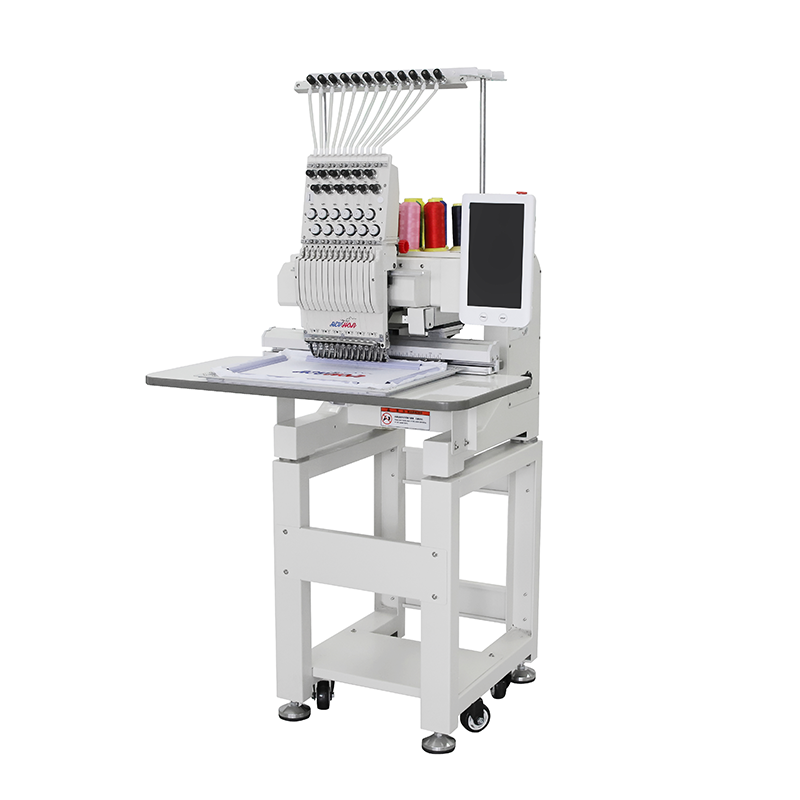
Conversely, modern customization trends demand a highly agile approach. Many successful shops now utilize responsive equipment like the revhon small area computer embroidery machine. These agile units provide exceptional benefits for fast on-demand customization. They excel at rapid prototyping for fashion brands. They heavily support highly profitable low-to-zero MOQ business models.
Agility always comes with distinct operational trade-offs. You will naturally experience higher per-unit costs on massive bulk runs. You are also heavily limited by your maximum physical design dimensions. You cannot stitch a massive jacket backpiece on a compact, agile frame.
We recommend a clear, data-driven shortlisting logic for all buyers. Guide your procurement team to audit historical order data thoroughly. Compare your average units per order directly against your average design size. Commit to a specific equipment class only after analyzing this hard data.
| Operational Feature | High-Volume Setup | Agile Compact Setup |
|---|---|---|
| Optimal Order Size | 250+ identical pieces | 1 to 50 custom pieces |
| Setup Speed | Slow (heavy framing limits speed) | Fast (lightweight hoops move quickly) |
| Space Utilization | Requires massive open floor plans | Fits easily in restricted workshops |
| Ideal Profit Model | Low margin, high total volume | High margin, low total volume |
| Market Focus | Corporate uniforms, large events | Personalization, boutique drops |
Purchasing capital equipment requires strict, multidimensional evaluation processes. You must scrutinize potential manufacturing partners incredibly closely. When choosing a reliable embroidery machine working area supplier, look far beyond basic marketing brochures and website claims.
Mechanical integrity is your absolute primary concern during evaluation. Expansive sewing fields are highly prone to intense operational vibration. They frequently suffer from visible registration drift during long production runs. Registration drift means your outlines will not align properly with your fills. You must require hard, verified data on pantograph stability.
Always verify their specific drive-motor specifications before signing contracts. Servo motors generally offer much better precision than standard stepper motors across wide distances. They correct errors instantly, ensuring cleaner designs on large beds.
Compliance and ongoing support separate excellent suppliers from terrible ones. Verify regional replacement parts availability immediately. Review their warranty terms line by line to spot hidden exemptions. Demand guaranteed service response times through a formal Service Level Agreement. Unexpected machine downtime completely ruins your carefully planned lead times.
Ensure the supplier provides accurate, real-world production yield tables. Do not accept theoretical maximum output numbers. You need actionable data based purely on actual factory conditions.
For your immediate next-step actions, request a live technical demonstration. A raw video benchmark stitch-out is also acceptable if traveling is impossible. Force the supplier to utilize the exact spatial extremes you plan to operate within. If the stitches at the outer edges look sloppy or misaligned, walk away from the deal instantly.
Profitable MOQs and accurate lead times cannot be planned safely in a vacuum. You must strategically reverse-engineer them from the hard physical realities of your equipment. Software calculations mean absolutely nothing if your physical frames cannot support the required workflow.
Align your final machine investment strictly with your core daily business model. Do not buy a massive flatbed unit if your revenue relies on fast-turnaround, small-batch customization. Buy the specific machine footprint that fits your average daily order profile perfectly.
Take decisive action today. Audit your current production bottlenecks rigorously. Track exactly how much time operators spend hooping garments versus actively stitching them. Request a professional technical consultation to match your average order profile with the correct machine specifications. A properly sized sewing field guarantees better profit margins, faster turnarounds, and substantially happier clients.
A: Larger areas require more complex setups and longer staging times. These machines sit idle while operators load heavy frames. You must enforce higher order volumes to absorb these fixed labor costs. Without higher MOQs, your extended setup expenses will completely destroy your profit margins.
A: Yes, you can achieve this through splitting the digital design and physically re-hooping the garment. However, this severely negatively impacts your lead time. It also heavily increases the risk of visible registration errors. We generally do not recommend this tedious approach for standard commercial production.
A: Small batches on agile machines can often turn around quickly in 24 to 72 hours. Bulk orders on large multi-head setups typically require two to four weeks. Bulk timelines must meticulously factor in detailed digitizing approvals, complex supply chain logistics, and continuous machine runtime limitations.
A: Look closely beyond the prominently stated maximum dimensions. You must heavily prioritize physical frame stability under stress. Check the X/Y axis motor types carefully, favoring precise servo motors over cheaper stepper motors. Finally, demand verified stitch accuracy data for complex designs placed at the absolute extreme edges of the sewing field.


